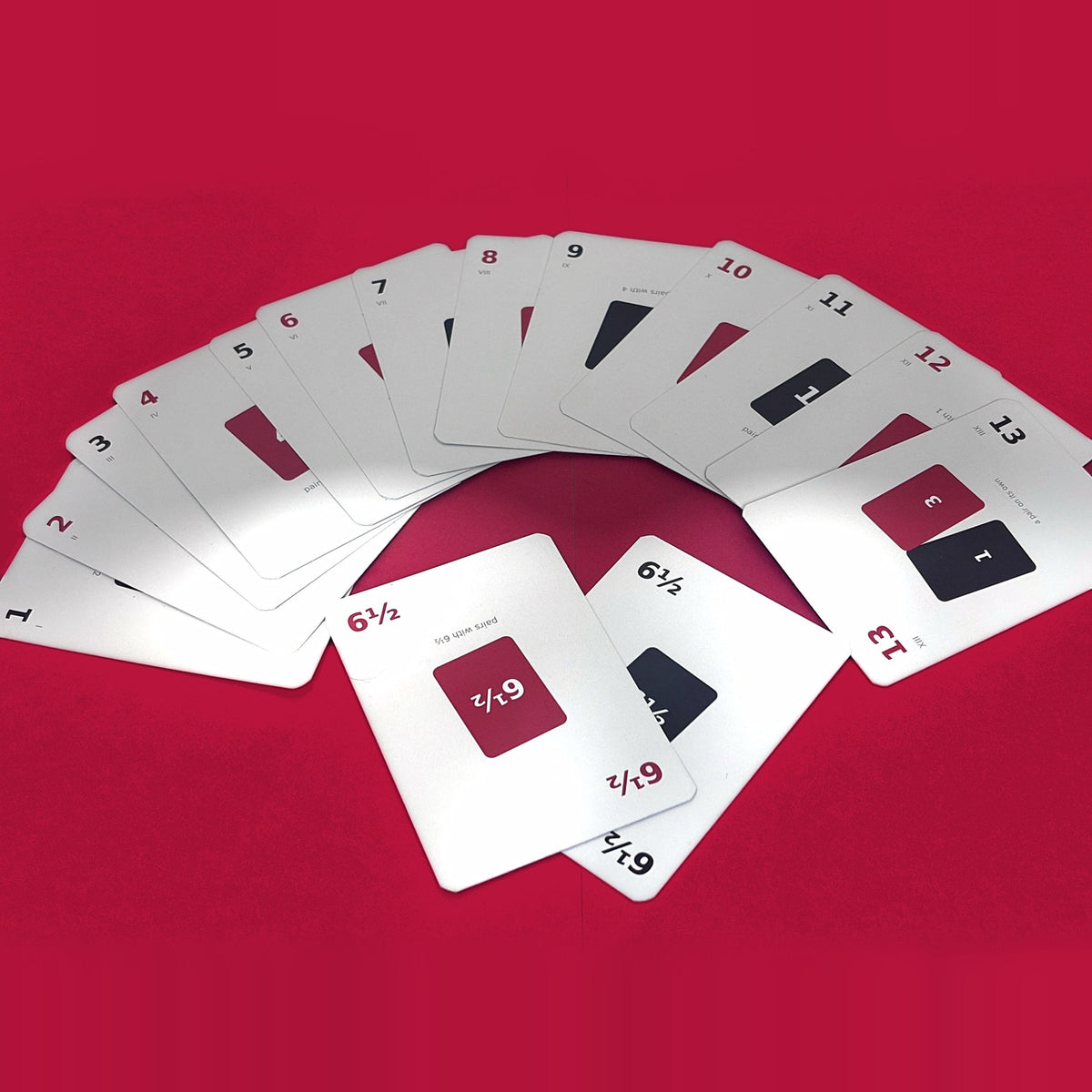
A friend told me about a game of THIRTEEN at her table the other night. Her son laid down a 10 and a 2, completely sure of himself. She looked at it, and she had to stop and think before she was certain. Not for long. But she had to think.
She can add. That is not the issue. The issue is that thirteen makes you think in a way that ten never does.
Someone always notices
The 10 and the 2 did not survive, of course. Wrong pairs never do in this game, and that is one of the things I like most about it.
In THIRTEEN, everything on the table is information. You are watching what people put down, what they ask for, and what they take. You are quietly building a picture of who is holding what, because that picture is how you decide who to ask next and whether to spend your lie. A pair that does not actually add to 13 corrupts that picture for everybody at the table.
So the table has a strong reason to care. Somebody comes back to it a turn or two later, looks again, and says hang on. It is rarely the person who laid it down. It is almost always someone who was counting.
What I find funny is the pause before the correction. The moment where an adult who has been adding numbers for forty years thinks: is that right, or am I the one getting it wrong?
That pause happens a lot. So, being the sort of person who cannot leave a small question alone, I went looking for why. Here is the geeky question I ended up with, and the answer, which turned out to be more interesting than I expected.
Nobody ever drilled thirteen
There are only five pairs that make ten: 1 and 9, 2 and 8, 3 and 7, 4 and 6, and 5 and 5. Those five get drilled into us relentlessly in the first years of school, over and over, until they stop being sums at all and become things we simply know. They are treated as the single most useful set of facts in primary maths, and the whole point of the drilling is to turn effort into instant recall (Hit The Button, Velox Math).
Thirteen has six pairs: 1 and 12, 2 and 11, 3 and 10, 4 and 9, 5 and 8, 6 and 7. Nobody ever drilled those. Not once.
So when you sit down to play, your brain has no stored answer to reach for. It has to work it out. That is the whole difference between knowing and calculating, and you can feel it happen.
Every pair is a big-number pair
The most reliable finding in the research on mental arithmetic is called the problem-size effect: the bigger the numbers, the slower we are and the more mistakes we make. Something like 8 plus 7 sits well inside the range people find genuinely effortful, while 3 plus 2 does not (Carleton University).
In THIRTEEN, every pair adds to 13. There are no small, easy ones to coast through. Every single decision at the table is one of the harder kind.
Every pair crosses ten
There is another thing going on. Sums that cross over ten are not stored as single facts the way small sums are. They get worked out in steps: get up to ten first, then add whatever is left over. It is taught explicitly as a strategy, with a name, because it genuinely is a multi-step process (NCETM).
Every pair in this game crosses ten. Every one.
And you are doing it while hiding your hand
Here is the part I think matters most. At the table you are not sitting quietly doing arithmetic. You are keeping your hand concealed, tracking who asked for what, working out who is probably holding the card you need, and deciding whether this is the turn you use your lie.
When you load someone's working memory like that, their arithmetic measurably suffers. Recall slows down, errors go up, and people fall back on simpler, clumsier strategies (Imbo and Vandierendonck, Cragg and colleagues).
And there is one more wrinkle. Most of the time you are not adding two numbers at all. You are holding a 9 and asking yourself what you need to go with it. That is a different and harder job than checking whether two cards add up.
It gets easier, and that is the good bit
Play a few games and something happens that we did not design and did not expect.
The first game is slow. People count. There are pauses. By the fourth or fifth game, the pauses are gone and nobody is working anything out. The pairs have become known rather than calculated. People build the thirteens the same way they once built the tens, just in one evening instead of one school year.
Nobody gets smarter. It just stops being work, and what is left is the part we were after all along: watching someone you love lie to your face about whether they are holding a 4.
The one card that needs no arithmetic
There are two 6 and a half cards in the deck. One whole and one half. They pair only with each other, they are worth three points instead of one, and they require no adding whatsoever.
They are also, without fail, the cards everybody wants.
THIRTEEN is a card game invented by our family in Aotearoa New Zealand. It plays from age 7, takes 10 to 20 minutes, and you get one lie per turn. You can find it at thirteenthecardgame.