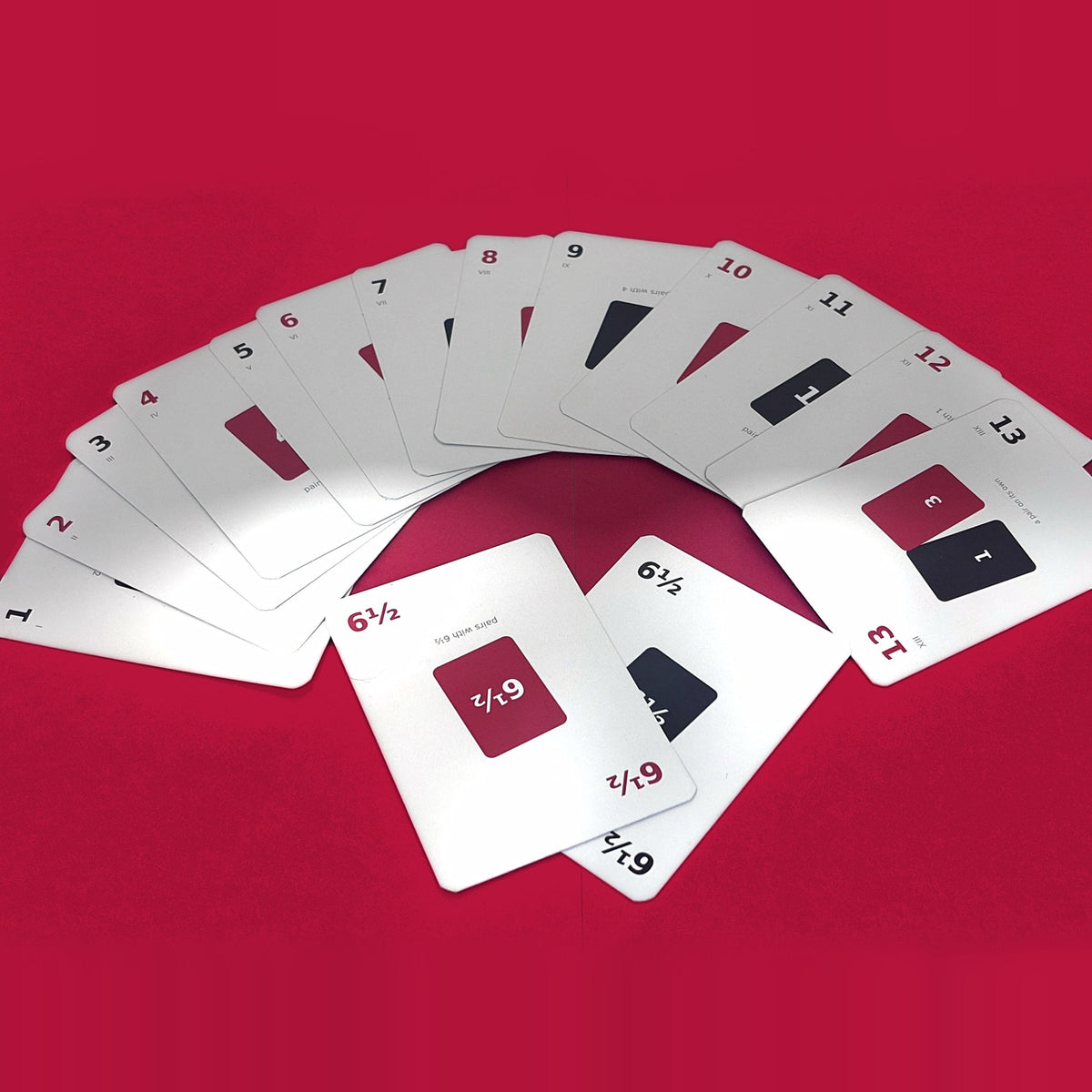
The full rules insert ships in every deck.
The aim
Pair your cards to 13. Every pair is a point, except the 6 1/2 pair is special that pair is worth 3 points. Every miss could be a tell — and a single someone can strip. Most pairs wins.
There are 31 points in the deck.
The deck
54 cards — four each of 1 to 12, four 13s, and two 6½.
Setting up
Deal 7 cards to each player, or 10 each for a two-player game. The rest of the deck goes face down in the middle as the pile. Lay down any pairs in your starting hand face up.
The pairs
Pairs only add to 13. Pairs worth one point:
1 & 12 · 2 & 11 · 3 & 10 · 4 & 9 · 5 & 8 · 6 & 7
Each 13 is worth one point and lays down alone.
The two 6½ cards pair each other and are worth three points.
Your turn
- Lay down any new pairs face up.
- Ask another player for a card that pairs one in your hand. If they hold it, they must hand it over. Lay the pair down and keep asking.
- Once per turn you may lie — ask for a card to start a pair, or ask for a 13. Hit, and you can truth-ask to pair any card in your hand.
- Miss any ask and your turn ends. If you still have a card in your hand, you can pick up from the pile.
A turn is a hitting streak. Keep going as long as you keep hitting. The moment you miss, the turn passes and you can pick up from the pack. If no cards left in the pack, right at the end of the game, the turn just passes.
Just made a Pair A pair formed in your hand by picking up a card from the pack at the end of your turn, must wait there until your next turn — then lay it down first. Keep a poker face. If another player guesses what you are sitting on, they can pull the pair out from under you. Pairs made during your turn must go down straight away.
The lie
You get one lie per turn, and it refreshes at the start of every turn.
A lie lets you ask for a Single whose pair you do not hold. Every hit ask is a public tell (as it is a Single you didn’t put down), and every missed lie-ask is a bluff. But watch out using your lie has a cost: a hit and your next ask is readable because that is now a truth-ask.
Four ways to use it
Fish. No lead, no clue — cast for information and see what surfaces. If you hit, you get to truth-ask next.
Hide. Your hand is thin and everyone can see it. Lie about what you are holding so nobody comes hunting.
Strip. You have watched someone miss an ask, so you think you know what they are holding. Lie for that card, then truth-ask another player for its pair on the same turn — taking both in one turn.
Survive. Had your last card taken? Lie your way back in. See below.
Remember to vary when to use the lie, and will sometimes truth-ask a player you believe does not hold the card you want so you don’t make a pair…(to avoid pairing yourself out).
Read the tells
Every missed ask could be public information. If Bobby asks for a 2 and misses, whoever holds the 2 knows Bobby may have the 11. Watch who asks whom — and watch who has spent their lie.
But a miss can also be a lie landing exactly as intended. That is why a tell is a read, never a fact — and why the same miss can be worth acting on or worth ignoring, depending on who made it.
Singles
A single is a known card left in your hand at the end of your turn — easily stripped.
Going out, and coming back
You can only knock yourself out. No other player can end your game.
There are two ways out:
- You pair every card in your hand on your turn.
- Someone took your last card. But wait — use your lie on your next turn to try to Survive.
On that return turn you must use your one lie to ask any player for any card.
- Hit and you are back in with one visible card, and you must truth-ask that card's pair.
- Miss and you are out.
The strategic move for your truth ask is to choose a player unlikely to hold the card, deliberately missing the truth-ask, so you can then pick up from the pile, and survive with two cards. Pair down the known card instead and you go out empty-handed with your lie spent.
Two scoreboards
Once you are out, you keep every pair you have scored, so keep them tidy in front of them so you can count them. Elimination order and pair count run in parallel, and they do not always agree.
You can be knocked out and still win if you have banked more pairs than anyone left playing. You can be knocked out three-quarters of the way through and still win. You can take the last pair and still finish second.
Count the cards
When all 4 of the same pair that add to 13 are on the table, flip them face down — but keep them close. Every flipped set narrows the field.
The game breathes. Early on the information space widens as face-up pairs accumulate. Later it narrows as the 4 pairs complete and get flipped away. Your hand size rises and falls as well.
As the pile empties, the game accelerates. By the endgame it is a probability puzzle: what is left to pair, who asked what last, and where do the last Singles sit?
Tips
- Do not rush to empty your hand.
- A large hand can be a liability as it gives the other players better odds when fishing.
- Watch who misses and remember what people are asking for… especially the 6½ card.
Bigger games
One deck plays 2 to 4 players. For 5 or more, add a second deck — 108 cards and 62 points. Everything else plays the same.
2–4 players (5-8 players use a second deck) · Ages 7+ · 10–20 minutes
Co-designed by Angus & Caroline Rennie · Wellington, Aotearoa